Thursday, February 27, 2014

Basic Fantasy: Too Weird to Live, Too Rare To Die

For RPG nerds in general and Old School clone enthusiasts in particular, the question of "which system to use?" is about as close to a spiritual dilemma as they come.  Thousands of forum posts and millions of words have been devoted to defenses of System A vs. System B for use in different settings, needs, styles and formats.  As much as I've said that this new campaign is as "back to basics" as possible, I do have a handful of requirements:
  1. Ascending AC: Honestly, the only real sticking point.  I know it's "totally easy to figure out" and "not as big a deal as it's made out to be," but descending AC has straight-up never made sense to me. 
  2. Single Book Game: At this point, I'd rather start out with a smaller game that I can bolt stuff onto than a larger one that would need rules taken out.  I want a rules set that's closer to the Basic philosophy than the Advanced one.
  3. Simple Enough To Wing It: Tying into the single book game aspect. I want to be able to put together stats for a vampire coffin mausoleum golem in under two minutes, or create a magical artifact with a limited amount of bookkeeping and balancing
  4. Race and Class Separate: I really love Race As Class as a concept, but it seems to be a much bigger sticking point for other people.  People love to play their Dwarven Clerics, Elven Thieves and the like.
  5. Cheap Or Free: If my players want a copy of the rules, I don't want them to have to throw $30 down for one.  That money would be better spent on cardboard minis, Chessex maps and beer.
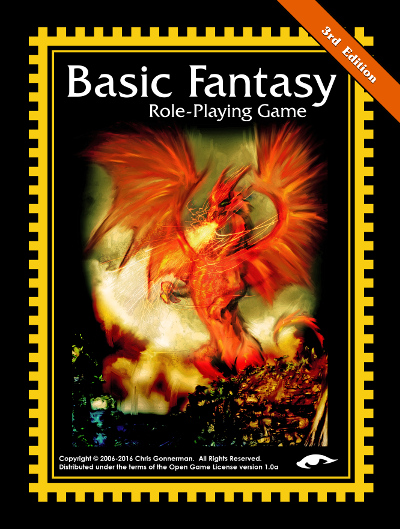
So with all those things in mind, one game stood out.

http://basicfantasy.org/images/sitecover.jpg

I feel like there are two different types of "old-school games" on the internet these days: your retro-clones that try to exactly mimic the rules of existing out of print games (your Labyrinth Lords and OSRICs) and the games that take an old-school approach or rules framework in order to create something wholly original (your Stars Without Numbers and Crypts and Things).  Basic Fantasy is sort of an odd duck in that Old School Renaissance/retro-clone marketplace.  It makes enough changes to the original Basic D&D rules set that it can't really be considered a retro-clone, but it is still closer in rules and tone to that framework than any other RPG.  For me, it hits that sweet spot with simple, streamlined mechanics that are nonetheless compatible with anything labeled B/X, BECMI, LL, etc.

Like all campaigns, there will be house rules, notably to get rid of the Medicine Cabinet saving throws that Basic Fantasy inherited from Mentzer and Moldvay.  I'll probably replace them with Swords & Wizardry's single save with class bonuses (when did Swords & Wizardry turn into AD&D?) but I don't want to do too much tinkering.  Basic Fantasy gives me a system that I am fairly comfortable following RAW and I want to do that as much as possible.

(now can I retroactively add this to Tenkar's Basic Fantasy Role Playing Blog Appreciation Day?)

Wednesday, February 26, 2014

Brand New Name, Same Dumb Stuff

Thought I'd spruce up the ol' layout since I'm back with a new choice men's adventure movie poster.  To paraphrase Michael Caine, "I have never seen Dark of the Sun, but by all accounts it is terrible. However, I have seen the movie poster that was made for it, and it is terrific."

Tuesday, February 25, 2014

On Returning

I basically stopped writing this thing because I hadn't played or GMed a roleplaying game in years.  All of the prep, house rules and roleplaying ephemera was being created with no eventual end goal and it was really getting me down.  In the two (!) years since I last posted, my whole life has gone through a lot of changes and my free-time priorities shifted from solitary bookkeeping to basement shows and tattoo parlors.  I shaved my head and grew a beard, I spent my spare cash on records and a drum kit, and I made some real local friends in the Philadelphia area.

Friends who thought it would be cool to learn how to play Dungeons & Dragons someday.

And when I started to prep for our game, I started revisiting these blogs.  I don't think I'll have to draw a single map thanks to Dyson Logos, I know my friends will all get a kick out of Jeff Rients's Carousing Rules and I met a lot of rad folks through the whole RPG blogosphere, who all seem to still be doing great stuff.

I can't say that anything I'm gonna be doing is groundbreaking.  I'm taking a real back-to-basics approach to this game, since I am now an adult with real life responsibilities and at least one concert to go to every week.  But I am gonna have a hell of a lot of fun on a very limited budget.

Monday, June 11, 2012

Please Advise: The Effects of High Temperatures on TSR Products

A question that I think only the assorted RPG blogosphere could answer:

I'm having my current apartment heat treated for bedbugs at the end of the week. This entails heating everything in the room to a temperature of over 150 degrees F. I happen to have a fair amount of board games, RPG boxed sets and polybagged comics and modules about this apartment.

Does anyone have any experience with the effects of high temperatures on these sorts of items? I can seal them up in plastic bins and drop pesticide strips in them, but they'll have to be in there for a minimum of 3 weeks.

Saturday, June 2, 2012

Retro-Stupid: The Ground Rules

Once I got this Retro-Stupid Dungeons & Dragons ball rolling, it picked up a lot of momentum. A quick poll of my friends via Facebook netted enough interest that I had to cap the number of players at SEVEN.

Seven assorted dudes with experience in a wide variety of gaming and role playing environments. Eight dudes (counting me) who have absolutely NO experience with Basic style D&D and all born after the release of the Mentzer Basic and Expert sets in 1983.

With that in mind, here are some of the ground rules that I'm following in the development of this game:

1) A Cut Above the Ordinary

I'm not super interested in running a meat grinder campaign. Though PCs may die or be horribly disfigured over the course of the campaign, they're still assumed to be a cut above the average spear carrier or pig farmer. That's not to say that humble beginnings aren't allowed, but there should be the spark of greatness in them.

2) A Whole Different Appendix N

None of us really grew up reading the sword & sorcery pulp stories that inspired so much of old-school Dungeons & Dragons. To the best of my knowledge, everyone has read Tolkein, but a lot of our gaming inspiration comes from sources from the last two decades. Common denominators include Magic: the Gathering, console and computer RPGs and adventure gamebooks, which I'll probably be talking about at greater length in the future.

3) History Is Written By The Players

There's not going to be a thousand-year history or intricate political alliances; the stuff that the PCs accomplish will help shape the world that they live in. If someone dies defending a village from some vicious wereboars, the villagers will remember their valiant struggle and returning adventurers who were present will laud their accomplishments.

4) Stick With The Core, Bolt On Some More

I want to try and run the game as close to Rules As Written Basic D&D as I can, with a couple of tweaks from Swords & Wizardry to speed things up at the table. I am going to try and make any house rules that I put into effect additions on to the base as opposed to wholesale modifications to the core mechanics.

5) Relax and Have Fun

This is not going to be a serious game. If I feel or the group feels like something is fun, we're going to do it, especially if it's stupid or anachronistic. Ultimately, we're all looking to kill some monsters, find some treasure and maybe save the world this summer.

Tuesday, May 29, 2012

Retro-Stupid: How I Learned to Stop Worrying and Just Wing It

Now that I have a little bit of disposable income, I've decided to take a look at buying a few quality board games. On top of classics like Carcassonne and Dominion, I discovered a new card game called Epic Spell Wars of the Battle Wizards: Duel at Mt. Skullzfyre.


The art for this game is the best kind of bonkers - weird Superjail meets Adventure Time fantasy with exploding heads and sentient testicles murdering people. On top of that, it is hella inspiring. It reminds me of the best parts of the Retro-Stupid style of Dungeons & Dragons practiced by a fair amount of people in the RPG blogosphere: anachronistic, tongue-in-cheek, and low-prep craziness. And it got me thinking.

I've been trying to muster potential players for the Vomorhin campaign that I have been preparing, but putting together a house-rule set for Swords & Wizardry, designing a city (which is by far the hardest fantasy setting to create) and work out political alliances and a thematically accurate world has frankly been a pain in the ass. So what would it be like if I just didn't care about how the world was put together?

I texted my friend Ethan about the idea:

8:11 PMme: Wanna play in a retro-stupid as hell D&D campaign? Basic Box style with weird video game-style boss monsters and magic that makes people explode?
Ethan: Yeah, you've been trying to do that a couple times now!
I wanna be an orc
Or an ogre
Smash.
8:12 PM me: Gotcha. I will write an Orc class.


Monday, May 21, 2012

Dispatches from Vomorhin: The 4 Scions of Creeshus

As one of the most powerful and least sane wizards of his time, Creeshus made a number of pacts with nefarious entities in his time as the ruler of Vomorhin. Some were simple transactions of life for power, some wanted artifacts or the delivery of prophesied do-gooders, but others were more... personal in nature. As a result of these consortings, Creeshus was blessed with four children of various monstrous heritages. But life in Creeshus's towers was often as unstable as the rest of the city. If he wasn't meddling in their affairs and trying to shape them in his own image, he was outright ignoring them or imprisoning them in a pocket dungeon dimension.

It was years ago that the four siblings came to their decision. Though their circumstances were vastly different, each knew that the city could not survive with their father as its ruler. However, none of his scions wished to take his place on Vomorhin's throne; the potential for betrayal and infighting was too great. So the decision was made to open the city to a new form of government, but one that could not touch the children of Creeshus. Each would have their own domain over the city, from diplomacy to city defense, where they exercise their influence over Vomorhin without ever officially ruling.

The new government of Vomorhin may be overjoyed at their new functioning economy and rising place in the world, but no one harbors the illusion that they are in control of the city. The whole experiment continues under the watchful eyes of the children of Creeshus and every civic leader knows that it could all be burned to the ground if they ever decide to change their mind.